Edit and complete
Edit the HPI, reconcile medications and allergies, and review gaps. The physician manually enters the examination, independent assessment and plan.

Asclepius 8.0 · Clinical Intake
Synthetic evaluation · desktop, web and tablet interfaceA checked encounter, a patient’s own account and a draft the physician can trace back to its sources. Keep the conversation moving while clinical judgment stays with the physician.
Clinical Intake 8.0 is restricted to fictional data. The native iPhone companion remains version 7.0.
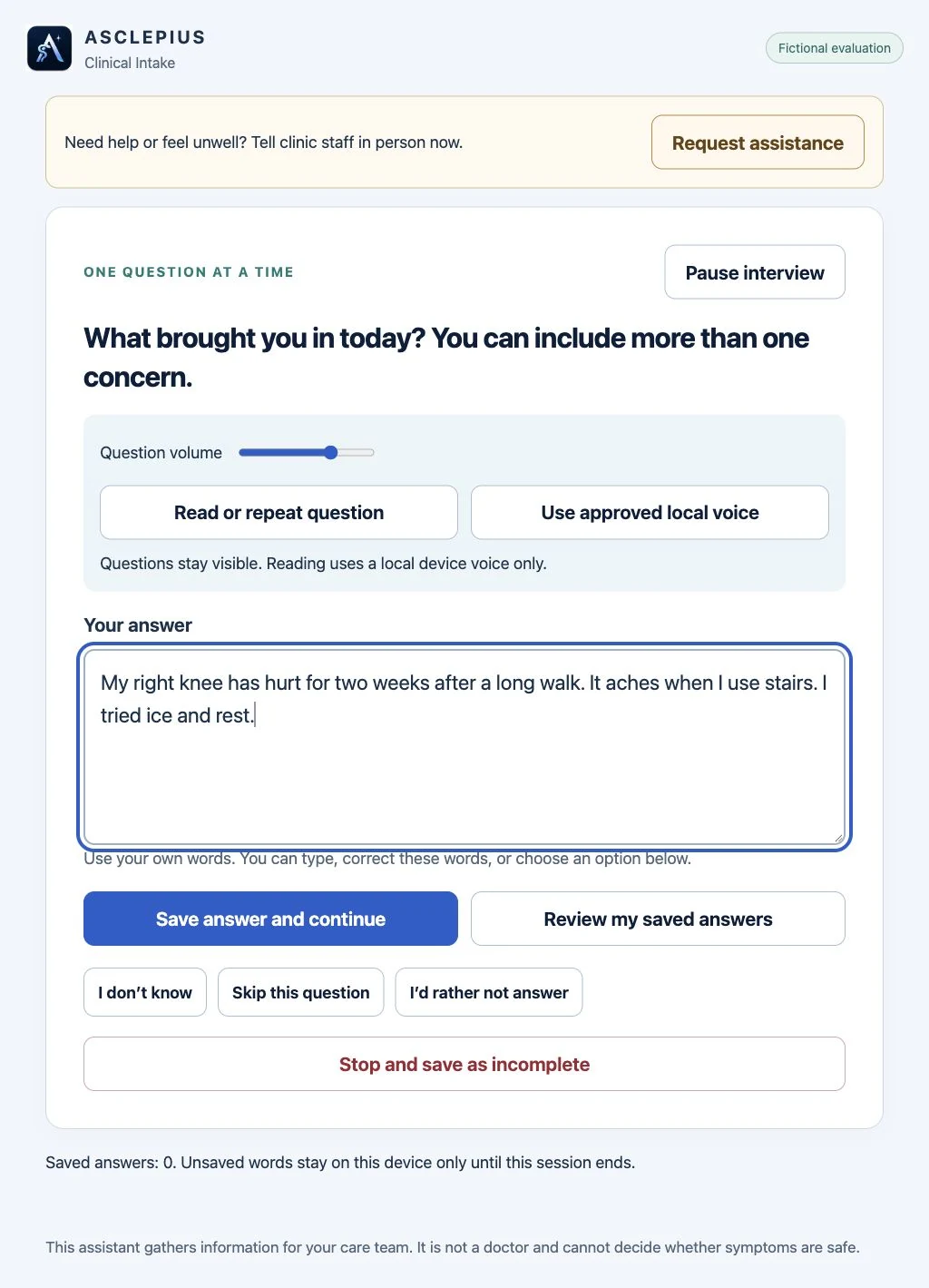
From check-in to source review
Check the name, birth date, MRN and its assigning authority against registration. Confirm the exact encounter and an authorized physician before issuing a single-use handoff.
After identity confirmation and consent, the text interview asks one relevant question at a time. Patients can correct answers, pause or stop. Unknown, skipped and declined responses stay distinct.
Review the draft beside the original questions and exact patient quotes. Unvalidated diagnostic considerations are prompts for physician assessment, never an autonomous diagnosis.
Human assistance comes first. A potentially urgent concern interrupts routine intake and asks for immediate in-person help. Staff records ownership; acknowledging a request does not clear the urgent hold or prove help has arrived.
Physician-controlled documentation
Edit the HPI, reconcile medications and allergies, and review gaps. The physician manually enters the examination, independent assessment and plan.
Compare the original draft with saved note versions. Explicit approval binds the current sources and note; a changed version requires fresh approval.
Copy approved text or download text, JSON or an offline FHIR R4 collection. A separate action can add the approved note as a supporting source in the revenue workflow.
A history note is not a care order or coverage determination. Reuse does not create an order, establish billing justification or submit anything to a payer. FHIR export does not write to an EMR.
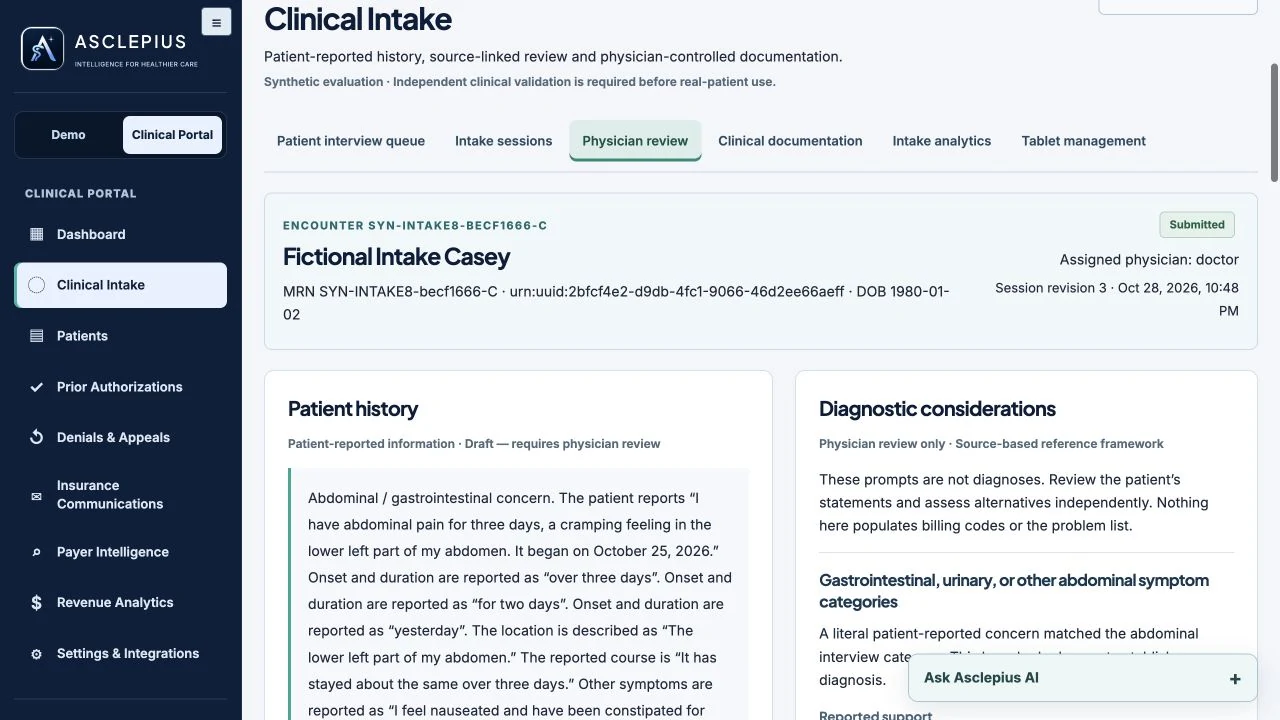
Evaluate the real workflow
Explore headache, knee pain, abdominal pain, multiple concerns and an urgent assistance scenario. The examples exercise the same intake engine and leave approval with the physician.
Synthetic software checks covered the patient text interview, workforce review, note approval, version changes, exports and assistance handling. These checks do not establish clinical accuracy or suitability for real patients. The protocols and diagnostic prompts remain restricted to synthetic evaluation; real use requires independent clinical, security, privacy and organizational acceptance.
The default text interview and draft use deterministic, source-extractive logic. No live model is connected in the delivered evaluation. Optional physician-requested model organization needs an approved configuration and processing acknowledgment, and stays separate from the note. Voice defaults off; operator-approved local recognition and physical microphone testing remain prerequisites for a voice evaluation. There is no cloud speech fallback. Offline FHIR export is schema-tested, with no live EMR write.
The local desktop can preview patient view after signing the workforce user out. Its local address is not a shared-tablet server. A physical clinic tablet requires an appropriately operated HTTPS deployment, patient identity confirmation and clinic acceptance. Clinical Intake is the responsive 8.0 web interface; it does not represent a newly validated native iPhone build.